 |
||||||||||||
          |
||||||||||||
 |
 |
 |
||||||||||
 |
January/February 2016 Letters
I always look forward to reading about the literature of the war in The VVA Veteran. One of my favorite veteran authors is Philip Caputo. All great writers are good storytellers. Caputo’s writing, both fiction and nonfiction, passes the test of good stories. He is also a great verbal communicator. In an interview on NPR discussing his fictional work on the Sudan, he talked about how war affects our spirit and why it is crucial that we understand and confront the dark side that humans are capable of. He gave a more lighthearted yet poignant talk on “The Moth” about his experience as a war correspondent for a Chicago newspaper. I recommend them both highly. Kudos to The Veteran for the latest edition. Joe Walter
Reading the latest issue, I was glad to see Joe Haldeman listed among the authors. But you missed mentioning two books that he wrote about Vietnam: 1968 and War Year. Joe and I were both combat engineers in 1968. His two accounts are classics. Edwin Frank Golinski Lesperance
I enjoyed the review of Vietnam War novels in the November/December issue. To supplement your coverage of ground-war fiction, I’d like to mention three novels about the air war over North Vietnam written by the late Tom Wilson. As an Air Force captain, Wilson was an F-105F Wild Weasel Electronic Warfare Officer who flew one hundred missions over the North in 1966-67. He and his pilot, Maj. Jerry Hoblit, belonged to the 357 TFS, 355 TFW, at Takhli, Thailand. Wilson transformed his five hundred hours of combat flying into dramatic storytelling in his trilogy published by Bantam Books: Termite Hill in 1992, Lucky’s Bridge in 1993, and Tango Uniform in 1994. After his Vietnam War novels, he wrote six techno thrillers published by New American Library, the last, Black Serpent, in 2005. Tom passed away in 2014. Thanks again for your issue devoted to Nam Lit. W. Howard Plunkett
The headline on the cover of the November/December issue was somewhat misleading. I thought the “Literature of the Vietnam War” was going to be a list of the popular books service members read for relaxation. For instance, the sailors I associated with primarily read the books written by one Mr. Louis L’Amour. Roger L. Kopf Reading another well-written article from John Prados in the last issue provides those of us who were grunts in the 101st at the time, as well as others, further information on Lam Son. Prados leads the reader from the reality of our dwindling involvement in 1970-71 to joint operations with the ARVN (which in my own experience never worked as well as planned), and finally to a tragic conclusion of such magnitude that even the “higher-up house cats” of Saigon and Washington had a hard time covering it up. Over the years not too much has come out concerning this debacle and what the U.S. involvement and cost was. Prados clearly points out that the human toll would have been far greater without the incredible flying of the aircrews and the support on the ground. As often comes to light after years of critiquing the war—possibly doing a bad thing differently—I wonder how history would have treated the “stars” in Saigon if they had had the courage to stop Lam Son before the carnage started. It’s a real heartbreaker to read this type of story that happened too often during our war: To the Memory of all involved, both on the ground as well as in the air. John Gordon
The article on Lam Son 719 by John Prados was presented very well. The aviation units he described were responsible for the area south of Highway 9. My unit, 2nd Squadron, 17th Cavalry Regiment, was responsible for the area north of Highway 9. The 2/17 Squadron consisted of call signs Cheyenne Phantom, Assault, Banshee, and Condor. I was an AH-1G Cobra Fire team leader in Charlie Troop, Condor 27. Since John Prados directs the Vietnam War documentation project at the National Security Archive, I just wanted to have the 2/17th CAV mentioned. I enjoyed the article about Lam Son 719 and have enjoyed this magazine. Keep up the good work. John E. Barron
I cannot tell you how gratified I was to read Thomas C. Hall’s article about secondary traumatic stress in his PTSD & Substance Abuse Committee report. I am the wife of a Vietnam veteran and know all too well the hypersensitivity family members experience about their loved ones’ moods and the lengths to which family members go to avoid triggers and keep the outbursts to a minimum. It is a relief to finally see our secondary combat wounds recognized. For too long, we have been considered simply as collateral damage or the victims of friendly fire. Deirdre Morris
On Veterans Day 2015 a wrong was finally put right. James Fred (Freddie) Dykes III, a 20-year-old Lancaster, Ohio, sailor killed during the Vietnam War finally got the recognition he long deserved thanks to VVA Chapter 1045. Dykes was a weapons department seaman aboard the U.S.S. Frank E. Evans. The ship was on a training exercise on June 3, 1969, when an Australian ship, the Melbourne, hit it. The ship sank in less than three minutes in 1,100 fathoms of water. The VVA Veteran published a story by Louise Esola explaining why the original claim that the Evans was not involved in the war at the time was false. The Evans was part of Operation Sea Spirit, which involved forty vessels from seven countries. It was designed to show cooperation and combined force to the enemy. For over two decades, families, lawmakers, and survivors have been working to get the names of the men lost at sea on the Vietnam Veterans Memorial. The official stance has always been that casualties that occur as a result of training incidents are not eligible for inclusion on The Wall, although exceptions have been made. Repeated requests for the names of the seventy-four men lost on the Evans to be included on Vietnam veteran memorials have failed for various reasons and sometimes without a reason. That is, until November 11, 2015. This omission was brought to the attention of Chapter 1045 veterans, who overwhelmingly voted to right this wrong. The chapter had already erected a monument recognizing the twenty-eight men lost in the Vietnam War from Fairfield County. It was decided to have a separate plaque added to the monument that recognized the sacrifice made by Dykes and to unveil it on Veterans Day. The monument was draped with a Navy flag and topped with a sailor’s cap before the ceremony. Dykes’s mother Eileen, his sisters Jimmie Jean Summers and Sandi Tomer, and his niece attended the ceremony. The cap and flag were presented to his mother afterward. The fight still goes on to get the “Missing 74” names added to The Wall in Washington. But thanks to Chapter 1045, at least one of these veterans was honored and remembered by his hometown for his ultimate sacrifice. Donald J. and Carol West
In his letter in the last issue, Paul Engle wrote: “Most people do not know that to fly in the military is strictly voluntary.” However, there were exceptions. At any given time during the Vietnam War there were a small number of personnel in low-priority areas flying hand-held photo missions. They were drawn from an MI company or detachment’s imagery interpretation sections and were volunteers if enlisted personnel. If no enlisted men wanted to do the mission, the section OIC was automatically tasked with the job. In August 1968 one of my sergeants, who had been the aerial photographer since before my arrival, heard a sharp crack while bent over changing rolls of film. It was a bullet passing through the Huey over his head. He sat bolt upright. A second round then passed between his legs. With only about six weeks left, he was done: He figured there was a third round with his name on it if he continued. As section OIC, I flew all hand-held missions from then on until I left Vietnam. Gerald Ney What is the primary problem with the VA? A lack of professional leadership. The VA Health Care System is the largest in the U.S. Take a look at the leadership in other large health care systems. The administrators are professionals who have worked their way through the health care system, received advanced degrees in their specialty, and take continuing education courses. Now let’s take a look at the leadership in the VA: Political appointees with little or no health care administration experience. For example, former Rep. Mike Michaud, nominated to be the new Assistant Secretary of the Veterans Employment and Training Service. He won election to Congress, resigned to run for Governor of Maine, lost the election, and then sought this appointment. His qualification: He served as ranking member of the House Veterans’ Affairs Committee and chaired HVAC’s Health Subcommittee. Where are the bona fides that qualify him for this job? What training or advanced degrees does he have in human resources, resource management, or personnel management? What large health care organization has he managed? As far as I can tell, this man is not qualified to hold this position. Should he be confirmed by the Senate, he will land a six-figure political appointment in addition to his six-figure congressional retirement. How much confidence would you have in a medical doctor who never earned a medical degree, or even been involved with the medical system, except as a patient? That is exactly how much confidence I have in the political appointees at the VA. If you want a first-class health care system, hire the professionals who have the proper experience, credentials, and motivation to do a first-class job. Mack Gooding
On page 33 of the November/December issue you have a 155 howitzer mislabeled as a 105. As an old cannon cocker, it brings back memories. Joe Baeli VA benefits are affected if a beneficiary is convicted of a felony and imprisoned for more than sixty days. Disability compensation paid to an incarcerated veteran rated 20 percent or more is limited to the 10 percent rate. If the veteran is rated at 10 percent, the payment is halved. So what happens to the rest of the money the veteran was supposed to get? We Vietnam veterans want our full benefits payment checks while we are still inside the prison system. Meanwhile, the Department of Corrections charges us for health care, store items, clothing, and even meals. Everything we get must be paid for as soon as we get any money in our account. There are Vietnam veterans without TVs or radios. In addition, they have not seen a VA rep. They are forgotten warriors. No one cares that they served their country. Yes, we all make mistakes that we are sorry for. But we served our country with pride and honor and were willing to give our lives for our country. When does the taking stop and the giving begin? When will we receive the help we need? Robert Lightningbolt, Sr. Once again we must endure a letter from a member claiming to be a better veteran than the rest of us—and once again we have a member unnecessarily and unfairly feeling that he must defend his honor. Jefrey Mason of Pittsford, N.Y., responded in the last issue to a letter written by Manuel G. Trevino of San Antonio. Trevino questioned the patriotism of Americans who wear an American flag lapel pin. He implied that he is always leery of people who wear the flag pin, and says that it would be preferable for those people to wear achievement lapel pins, like the ones about which he boasts. He appears to be one of those “better-than-you” VVA members who contaminate VVA and persistently repel other members. Mason writes that he has no particularly glorious achievement pins, and sarcastically writes that he will be careful not to wear his flag lapel pin around Trevino. I am no longer active in VVA for just this kind of behavior among our membership. Just a few years ago, The VVA Veteran editor pledged not to publish letters that segregate classes of VVA members. Many members have complained about such divisive finger pointing, which is why there was a pledge to filter it. Although our VVA Constitution welcomes all members of the armed forces who served during the Vietnam War era, there has always been a faction of the membership that resents those of us who have never killed anyone. Most veterans would agree that wearing medals of war on civilian clothing can at times be completely inappropriate. As my father said to me when talking about his World War II medals, “There is no glory in killing people.” VVA should earnestly uphold its editorial policy pledge and focus on opinions that bind us as brothers. Phil Litteer
Here’s an issue that has bothered me for several decades. Along with thousands of others, I served in Vietnam as a combat engineer, disassembling booby traps and conducting mine sweeps in front of the infantry. However, their service is distinguished with a Combat Infantryman Badge. Ironically, my Marine friend David Trevino received a Combat Action Badge (CAB) during the same time period I served in Vietnam and he was a company cook. Everyone who served in combat since 2001, regardless of rank or MOS, gets the CAB award. But not those who served in Vietnam as combat engineers or in armored units. We killed the enemy and saved thousands of lives. Don’t we finally deserve to get the same recognition? Richard L. Williams
Many VVA members became familiar with Federal Form 4473 when they purchased a firearm at a sporting goods store or local gun show. Question 11g raises my ire: “Have you been discharged from the Armed Forces under dishonorable conditions?” Instructions clarify that should you answer “yes” to this question you will be prohibited from purchasing or possessing a firearm. Being dishonorably discharged from the armed forces is never a good thing. However, it can involve anything from thievery and assaulting an officer to disobeying direct orders. I do not believe that in most cases receiving a dishonorable discharge involves a violent criminal act such as murder or assault with a deadly weapon. I received an Honorable Discharge from the U.S. Army in May 1968 after serving a tour of duty with the 97th Grp. 6th Bn., 71st Arty. in Vietnam and therefore answer “no” whenever I purchase a firearm. However, I have always wondered why this question is on this form. Under the Ford and Carter administrations conditional and then unconditional amnesty (in that order) was granted to draft dodgers who fled to foreign countries and elsewhere when they received notices to report for induction. If these men received a reprieve for their transgressions (and many were labeled “heroes” when they were granted amnesty), then why not those who reported for induction and then received a dishonorable discharge? Why must some stupid act done while in service continue to be a black mark that prevents owning a personal firearm, while draft dodgers retain the right? This question has always irked me. While military veterans have to proclaim they received honorable discharges when completing this form, individuals who evaded the draft are not held accountable for their dishonorable act. I believe this question should be eliminated from this federal form. If not, additional questions should be asked concerning whether an individual received an induction notice during the draft period and, if so, did he report for active military duty as required? If the person answers “yes,” they did receive an induction notice, and then “no,” he did not report for duty as required, he should be denied purchase of a firearm. If he states “yes” to both questions, then it should be required on another line to state what unit(s) he served with during his last year of military service. These answers should be thoroughly vetted. Falsifying an answer to any questions on this form is a felony. I don’t know if other VVA members have ever thought of this question in this context. While most of us have moved on, some things should not be forgotten. Having to reaffirm our status as honorably discharged veterans every time we wish to purchase a firearm, while those who evaded their responsibilities are held exempt, should not be allowed. ATF should be required to provide an explanation. Brian L. Maas
|
 |
||||||||||
|
|
||||||||||||
 |
 |
 |
||||||||||
 |
 |
 |
||||||||||
 |
 |
|||||||||||
 |
|
|||||||||||
 |
 |
|||||||||||
 The VVA Veteran® is a publication of Vietnam Veterans of America. ©All rights reserved. The VVA Veteran® is a publication of Vietnam Veterans of America. ©All rights reserved.8719 Colesville Road, Suite 100, Silver Spring. MD 20910 | www.vva.org | contact us |
||||||||||||











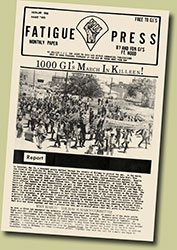 Fonda, who had not yet become “Hanoi Jane,” was leading soldiers she had met at the Oleo Strut, a local coffeehouse—an unlikely bastion for the antiwar movement in staunchly conservative CenTex. The Strut featured a shadow menu of mind-altering substances, and activists printed a counterculture newspaper there. Future filmmaker David Zeiger was a teenage employee. Much later, he chronicled the GI antiwar movement in the documentary film,


 Amdur to the Rescue: