|
||||||||||||
          |
||||||||||||
 |
 |
 |
||||||||||
 |
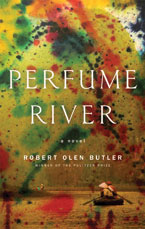
Books in Review, November/December 2016 ‘Perfume River’ Is Not a Vietnam War Novel—Or Is It? REVIEW BY MARC LEEPSON
Here’s what the acclaimed and prolific novelist and short story writer—and Vietnam War veteran—Robert Olen Butler had to say on that subject in 1987. The occasion was a writer’s roundtable discussion at the 1987 VVA National Convention with fellow award-winning novelists Tim O’Brien, Philip Caputo, and Larry Heinemann. “If the prime motive for writing is that you have a sense that the world fits together beneath this flux of experience, if you aspire to show that,” Butler said, “then saying we are Vietnam [war veteran] novelists is like saying Monet is a lily-pad painter.” I couldn’t help but recall that memorable line as I was reading Bob Butler’s latest novel, Perfume River (Grove Atlantic, 273 pp., $25). This is an elegant work of fiction that centers on a Vietnam War veteran. It includes flashbacks to the war zone, a character who fled to Canada to avoid the draft, a woman who was active in the anti-Vietnam War movement, and another Vietnam veteran deeply scarred emotionally by the horror of his war experiences. Another primary character, the son of that veteran, almost certainly has secondary PTSD. Yet Perfume River is not a Vietnam War novel. Yes, Butler deals with the legacy of the war on most of the book’s pages. But he’s also dealing with other, more universal issues, including life and death, love and marriage, mental illness, father-son relationships, and other psychological family entanglements. Butler, who served in Army intelligence in the Vietnam War, has been down this road before. His first published novel, The Alleys of Eden (1981), was a well-crafted book centering on an American Army deserter who falls in love with a young Vietnamese woman and lives with her for four years in the back alleys of Saigon. They are forced to flee to the United States during the 1975 communist takeover. In this compelling story the haunted couple and the crowded, dangerous maze of Saigon alleys become a metaphor for the pain and suffering caused by this country’s participation in the Vietnam War. The war and its legacy also were themes in Butler’s 1985 novel, On Distant Ground, a taut tale studded with illuminating flashbacks and realistic dialogue. The book begins in Vietnam during the war as a U.S. Army intelligence officer goes out of his way to free a Viet Cong prisoner. He is court-martialed in the States, then takes off for Vietnam in the war’s waning days in search of a child he believes to be his. The war and its legacy also are themes in three other Butler novels: The Deuce (1989), They Whisper (1994), and The Deep Green Sea (1998). And then there’s his best-known work, A Good Scent from a Strange Mountain, the 1993 Pulitzer Prize winning collection of short stories. Each of the fifteen stories is a beautifully realized first-person tale of a Vietnamese immigrant trying to adapt to life in southern Louisiana. All of these fictional works owe a great deal to Butler’s service in the Vietnam War. But Bob Butler, who teaches creative writing at Florida State University, has published eighteen other novels and short story collections that have nothing whatsoever to do with the Vietnam War, Vietnamese expatriates, American veterans, or the war’s legacy. In other words, he is far from being a “Vietnam War novelist.” In all of his books, as is the case with Perfume River, Butler has amazed me with his uncanny ability to bore deeply inside his characters’ hearts and minds and illuminate their deepest thoughts and emotions. It doesn’t matter if it’s a man or woman, a Baby Boomer, or a member of the previous or next generation. Butler consistently offers up believable and insightful evocations of his characters’ innermost feelings. He’s also adept at two of the novelist’s most difficult tasks: exposition and building a narrative to an unexpected ending. Butler gives us his characters’ back stories by flashing back and forth in time, getting the mundane (and consequential) details of their lives to flow smoothly into the narrative. He also keeps things humming along by dropping fast-moving action scenes into the plot periodically and by jumping abruptly from one character’s thoughts to another’s. Butler handles this seamlessly for the most part, even though the book’s two main characters have the same first name, Bob. He solves that one by calling the Vietnam veteran “Robert” most of the time. Robert Quinlan, said protagonist, is a 70-year-old U.S. History professor at Florida State. He suffered under the thumb of an overbearing, maladjusted World War II veteran father growing up. After college he joined the Army rather than get drafted, and chose an MOS that would all but assure that he’d be away from physical danger if he got sent to Vietnam. “He will do order-of-battle work,” Butler writes, “rather like research, rather like the things he learned to love in his four years at Tulane. Wherever they put him, he will be bunkered in at the core of a headquarters compound. It would take an unlikely military cataclysm—or a fluke, a twist of very bad luck, a defiance of an actuarial reality of warfare… for him to die.” That fluke does come to pass, although Robert does not die in Vietnam. He is, however, caught with his pants down (literally and figuratively) in Hue (where the Perfume River runs) the night the NVA invades the city during the 1968 Tet Offensive. What happens afterward haunts him for decades. What haunts the other Bob is an abusive Vietnam veteran father who drove him into mental illness. The other main plot involves Robert’s younger brother Jimmy, who fled to Canada just about the same time Robert shipped off to Vietnam. His father disowned him, his mother stood by his father, and his brother was caught in the middle. There would be no communication between Canada and the family at home for four decades, until the father breaks his hip. What happens then brings the plot to a boil. The ending is a surprise that’s only one of the many satisfying elements in this terrific novel.
|
 |
||||||||||
|
|
||||||||||||
 |
 |
 |
||||||||||
 |
 |
 |
||||||||||
 |
 |
|||||||||||
 |
|
|||||||||||
 |
 |
|||||||||||
 The VVA Veteran® is a publication of Vietnam Veterans of America. ©All rights reserved. The VVA Veteran® is a publication of Vietnam Veterans of America. ©All rights reserved.8719 Colesville Road, Suite 100, Silver Spring. MD 20910 | www.vva.org | contact us |
||||||||||||