 |
||||||||||||
          |
||||||||||||
 |
 |
 |
||||||||||
 |
Books in Review, September/October 2016 Forty Years Later: A Follow-up REVIEWS BY MARC LEEPSON
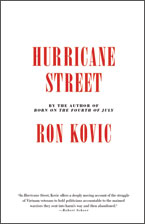
Here’s what I wrote on September 27, 1977, in my “Books Read” journal: “Born on the Fourth of July by Ron Kovic, 200 pages, read in two sittings yesterday. Riveting, powerful story of Kovic, gung-ho Marine, Vietnam volunteer, combat traumatized, severely wounded, paralyzed from the chest down and his struggle after returning home. Very moving, often bitter and emotional story of his physical and mental torture.” The book went on to become a best-seller, and Kovic became perhaps the best-known Vietnam War veteran from the mid-seventies to the late eighties. As the American public learned what happened to Ron Kovic, he came to symbolize for many the plight of severely wounded Vietnam veterans, as well as the dismal homecoming given to all veterans of the war. Many more people read Born on the Fourth of July in 1989 after the release of the Oliver Stone movie of the same name starring Tom Cruise. Stone—a Vietnam War veteran himself—won the Best Director Oscar for that unflinching film, which followed Kovic’s evolution from true blue to anti-establishment after he became a leader of Vietnam Veterans Against the War. The scenes of Kovic and other paralyzed VVAW members being manhandled at the 1972 Republican National Convention and then Kovic speaking at the 1976 Democratic National Convention are among the film’s most powerful moments. To mark the fortieth anniversary of the publication of Born on the Fourth of July, Kovic—who largely avoided the national spotlight after the movie was released—has come up with his second memoir, Hurricane Street (Akashic Books, 224 pp., $26.95, hardcover; $15.95, paper; $9.99, e-book). Published on his 70th birthday, July 4, 2016, the new book is narrowly focused on Kovic’s attempt to protest horrible conditions at the VA hospital in Long Beach, California, in 1974. Enraged by how he and other Vietnam veterans were being treated, Kovic formed and led what he hoped would become a powerful lobbying group, something he called the American Veterans Movement. With a small group of fellow Vietnam War veteran patients, Kovic made national headlines when he led the men in a takeover of the Los Angeles office of U.S. Sen. Alan Cranston in February of 1974. The men then went on a hunger strike. They said they wouldn’t take solid food or vacate the premises until the head of the VA, Donald Johnson, met with them to hear their grievances. After nineteen days and a not-so-cordial meeting, the men ended the sit-in and the hunger strike. Nothing much changed at the VA. Kovic then decided to stage what he hoped would be a large demonstration on July 4, 1974, in Washington, D.C., protesting the VA’s mistreatment of Vietnam veterans. He expected as many as one hundred thousand veterans to join a march through the Nation’s Capital. He could picture himself, he writes, leading the march, “carrying the AVM banner and American flag, wheeling down 16th Street, tens of thousands of veterans stretching behind us for miles.” But only about 150 people showed up. Kovic and his small group decided to take more headline-grabbing action anyway. They succeeded in making the national news four days later when they briefly took over the top of the Washington Monument and a bathroom in the White House. Media coverage quickly disappeared after the abortive takeovers. Except for his speech at the Democratic Convention in ’76, Ron Kovic essentially bowed out of the veterans movement, living quietly back in California. There is nothing quiet about Hurricane Street, however, which is based primarily on the diary entries Kovic made during the nineteen days he and other veterans took over Cranston’s office. Kovic writes colloquially in a short book—“a work of both memory and fiction”—his “own recollection of the strike and all that followed that spring and summer.” The fictional aspect of the book: Kovic has created two characters. One “is essentially a composite of several sight-impaired Vietnam veterans I knew when I was a patient at the Bronx and Long Beach VA hospitals,” he writes. The other “represents a number of seriously wounded veterans I also knew during that period.” Kovic reconstructs his story with periodic references to the composite characters and with much reconstructed dialogue. Which means that what he describes in the book in these sections is not literally true. Kovic admits as much, offering this disclaimer: “No doubt everyone involved will have their own way of remembering those days and giving their opinions on what may or may not have happened,” he says, “but this is how I remember it.” Even though the book is a mix of fact and fiction, Kovic does deliver the flavor of events, much the way his first book did. Hurricane Street is not among the most literary Vietnam War memoirs. Kovic’s style is plain vanilla. He is at the center of the tale, but to his credit, Kovic does not shy away from pointing out his own failings. In sum, this book is an evocative look at a band of dedicated, activist Vietnam War veterans and what they tried to do to better the lot of their fellow veterans in 1974. Today that seems like a far, faraway time and place.
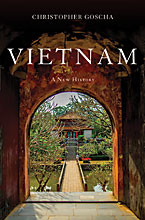
Goscha, an American who is a University of Quebec history professor specializing in Southeast Asia, focuses on “Vietnam’s own role in shaping its history” in this clearly written (if sometimes a tad too detailed) book, which begins in ancient times and runs to the present day. Covering Vietnamese history, society, culture, and politics, Goscha highlights what he calls the “country’s extraordinary diversity and complexity.” The latter parts of the book are replete with references and comparisons to what came before in Vietnamese history, primarily events related to the role of the Chinese and French conquerors of Indochina. Using a worthy combination of the best secondary sources, along with documents, letters, and other recently discovered or released primary sources, Goscha certainly does not ignore the American war. But the chapters on the war focus on the most important Vietnamese players, including Ho Chi Minh and other communist leaders and Ngo Dinh Diem and other noncommunist leaders. American presidents, politicians, generals, and war policymakers receive scant mention. Goscha is rigorously objective; but he does not shy away from analysis amid his historical fact finding. He points out the good and bad about both North and South Vietnamese leaders. His overwhelmingly negative conclusions about Ngo Dinh Diem convincingly counter recent revisionist work that has portrayed the first leader of South Vietnam as an upright man who valiantly fought against the communists and against being an American puppet, only to be betrayed by the Kennedy administration. Yes, ordering and abetting the coup against Diem (and his brother Ngo Dinh Nhu, who headed South Vietnam’s secret police) was an egregious error. But that disastrous business, Goscha convincingly argues, does not negate the fact that the Ngos, with “their characteristic arrogance and insensitivity,” were “nepotistic, authoritarian, and heavy-handed in their rule.” Despite “paying it lip service, Diem bypassed the [elected South Vietnamese] National Assembly, preferring to rule by decree, just like Ho Chi Minh,” Goscha notes. Plus, South Vietnam’s “judiciary was not independent of the state and had few oversight powers, which led to many of the same human rights abuses committed by the communists—arbitrary arrest, censorship, torture, execution, forced labor, and the use of concentration camps.” Despite the ideological differences between the Ngos and Ho Chi Minh and his closest advisers, Goscha concludes that the South and North Vietnamese leaders “clearly struggled to impose authoritarian rule and create the legitimacy for these two different Vietnams that had emerged from a century of French rule. Neither brooked any opposition to their right to rule.”
|
 |
||||||||||
|
|
||||||||||||
 |
 |
 |
||||||||||
 |
 |
 |
||||||||||
 |
 |
|||||||||||
 |
|
|||||||||||
 |
 |
|||||||||||
 The VVA Veteran® is a publication of Vietnam Veterans of America. ©All rights reserved. The VVA Veteran® is a publication of Vietnam Veterans of America. ©All rights reserved.8719 Colesville Road, Suite 100, Silver Spring. MD 20910 | www.vva.org | contact us |
||||||||||||













 A Great Duck Race
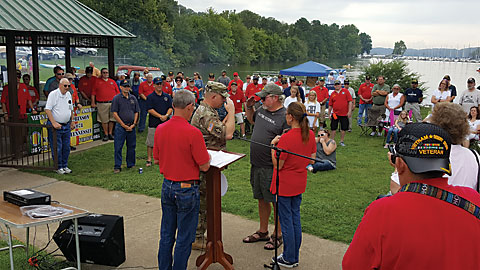 A Tribute to Modern War Veterans