 |
|||||||||||
          |
|||||||||||
 |
 |
 |
|||||||||
 |
Books in Review, March/April 2013 A War Memoir That Ventures Into A Heart REVIEWS BY MARC LEEPSON AND DAVID WILLSON
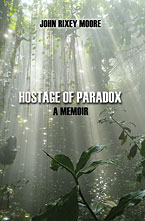
Our narrator, John Moore, the former Green Beret, is not a typical Army soldier. He has a degree in philosophy from the University of Virginia. That explains some of it. The only other Vietnam War memoir writer I can think of who had a degree in philosophy attained prior to war service is Ernest Spencer, author of the classic Welcome to Vietnam, Macho Man. The only other book I’ve read in which I had to look up the meanings of so many words was one by Alexander Theroux. The authors I was most reminded of while reading Moore’s book were Joseph Conrad, Herman Melville, and T.E. Lawrence. All of them wrote great, huge books of adventure, and they also used a lot of big words. Is that all that Moore has in common with these classical authors? Not at all. He also has written a fine book, one that ventures deep into a heart of darkness. John Moore is a smart, witty guy with a fine classical education and a huge appreciation of history, which is not typically displayed by most Vietnam veteran authors published by small presses. Moore writes that the 5th Special Forces Group in Vietnam took part in the infamous Phoenix Program. According to William Colby, the program’s head, it was responsible for the deaths of more than twenty thousand suspected Viet Cong. Moore says this process often was accomplished by a bullet in the head while the target was sleeping. He says he was part of SOG, and that this group was used “in the conduct of small-unit long-range reconnaissance, interdiction, and assassination missions into Laos, Cambodia, North Vietnam.” That is the subject of this massive book—specifically, Moore’s role in this program. One of the great delights of this book is the ability that Moore has to coin phrases or to pluck them from somewhere and use them. I especially enjoyed encountering “scented bosom of illusion” to describe Secretary of Defense Robert S. McNamara’s little group back in Washington, D.C. I also loved “sweltering pteridophyte ooze” for the field Moore slogged through in Vietnam’s jungles. Moore also refers to the jungle as the “Mesozoic wilds” and as the “Mesozoic boonies.” These Special Forces teams slogging in that ooze usually consisted of two American sergeants and a few Nungs, Chinese mercenaries. These few men often were kept in the dark as to what their agenda was, and I enjoyed reading Moore’s paranoid speculation about what he and his team were really being sent to do. Sometimes he figured they were being sent out to disappear, never to be heard from again, which is what happened to some of the teams. The Americans had no language in common with the Nungs, so they relied on hand signals and pidgin English of a rudimentary sort. This lack of clear communication added to the horror and confusion of the situations they often found themselves in when they encountered bad guys out in the middle of the vast tracts of wilderness where they were the aliens. As a reader, I got a powerful sense that Moore’s narrative was entirely written from his own experience, not heard second hand. The book is filled with suspense and sudden bloodshed, and it seems a miracle that Moore survived the events he describes with so much powerful, evocative details forty years later. Throughout the book, I was impressed by Moore’s humanity and consideration of others, especially for the members of his team and the Nungs, but also for the Vietnamese who cleaned the hootches, polished the boots, did the laundry, and the like. Perhaps being raised in various countries around the world prior to his time in the Army explains this, or maybe Moore is just one of those very few Americans who are not ugly to those who are different from them in appearance and culture. Whatever the reasons, this humanity sets this book apart. I grew to like the narrator a lot, especially his self-deprecating attitude and his honesty about everything, even about getting rank. As he states, rightly, in the highly stratified life of the military, rank does count. I also loved his recounting of his two R&Rs in Hong Kong. He spent his time in Hong Kong about the same way I did. Very quietly. He didn’t spend his time in bookstores as I did, but he did spend a lot of time riding the ferry, although he doesn’t mention the sign that advised against spitting. A reader can become drunk with the words in this book as they leave the page and enter the mind. It is so densely written and packed with action that it demands multiple readings. I’ve read many of the pages several times to savor the writing and the suspense. Moore’s prose envelopes the reader and takes him out of his world into a scary one, “a sclerotic black festival of brutal unknowns,” where dead men rise up out of “feculent excremental sludge.” Read this book. You’ll be, as John Moore puts it, “transfixed, like kittens in a box.” The author’s website is johnrixeymoore.com —D.W. John Rixey Moore’s follow-up memoir, Company of Stone, will be published later this spring. See David Willson’s review in Books in Brief. HOMECOMING
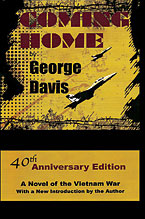
Technically, the screenplay was “original.” But the idea for the film came from a little-known novel of the same name, published in 1972. Written by Vietnam veteran George Davis, who flew Air Force jets out of Thailand, the book was re-published late last year in a 40th anniversary edition (HERE Books, 192 pp., $9.99, paper). The book’s plot has almost nothing to do with the story told in the film. In the film, virtually all the characters are white. In Davis’s book, most of them are African-American. The book’s main plot revolves around Ben, an African-American pilot in Thailand who decides he’s had enough of the war and vows not to fly any more missions. Meanwhile, back home, Childress, a former fellow pilot who also has no love for the war, chats up Ben’s wife with the sole aim of having an affair with her. There also are several subplots. One involves another pilot at the air base in Thailand, Stacy, who spouts anticommunist clichés, and his conflicted girlfriend back home. Another centers on Lt. Col. Milligan, a gung-ho type who can’t get enough of bossing around the other guys. There also is a lot of sexual activity, in Thailand and back in the U.S.A. The critics were mixed about the book (one of the first Vietnam War novels published) when it came out four decades ago. In his new Introduction, Davis calls the book “my raw, embarrassingly profane, painfully honest, first-born book—the one that is so much like the others, and yet so different.” This new edition also contains two of the 1972 reviews in toto. One’s a rave; the other is mixed to negative. I agree with the latter, written by Jerry Bryant and published in The Nation. This “is not an ambitious novel,” Bryant wrote. “It certainly is not a great one. It is self-consciously literary. It is clearly the work of a young man. And often the technique of the interior monologue results in characters who are cardboard stereotypes.” –M.L.
|
 |
|||||||||
 |
 |
||||||||||
 |
 |
 |
|||||||||
 |
 |
 |
|||||||||
 |
 |
 |
|||||||||
 |
 |
|
 |
||||||||
 |
 |
 |
|||||||||
 The VVA Veteran® is a publication of Vietnam Veterans of America. ©All rights reserved. The VVA Veteran® is a publication of Vietnam Veterans of America. ©All rights reserved.8719 Colesville Road, Suite 100, Silver Spring. MD 20910 | www.vva.org | contact us |
|||||||||||











 Last To Leave: